Showing posts with label farming. Show all posts

May 31, 2011

Pinching Myself

I'm going to dare and write a sentence that is not usually found among these pages:

Things are going quite well on the farm.

Thanks to the addition of the new fence around the garden, it looks like I might get more than three beets this year.

Here we have about six rows of radishes and four rows of lettuce (also unheard of before the new fence -- the deer have good taste).

Next we have the second round of tomatoes in addition to some peppers, on the left, all weeded and mulched and supplied with drip hoses. On the right, that large, leafy plant in the foreground is one of our signature volunteer sunflowers. Behind it are two rows of beets straddling a wide row of arugula (or "rocket" for those of you across the pond).

For dinner, we had some of said lettuce, radishes, and some of the lovely herbs that are also thriving.

In addition to the garden successes, in this same week, we sold our hay from last year. (We're one step closer to breaking even on that score!)

The rain, which has been a little too much for most people around here, has made it easier for us to weed and keeps things growing in our little microcosm.

The garlic and onions and aronia berries are all doing well.

After a couple of years of strategic abandonment, the clematis are a profusion of color.

Even the long, lost kitty, Tsarmina, returned to the fold! (While she was away, her six kittens went to that great cat box in the sky, but we'll save the negative stuff for one of the many other blog entries about the farm.)

March 15, 2011

Woodhenge

The planets were aligned for Lizzie last weekend.

But first, a little background...

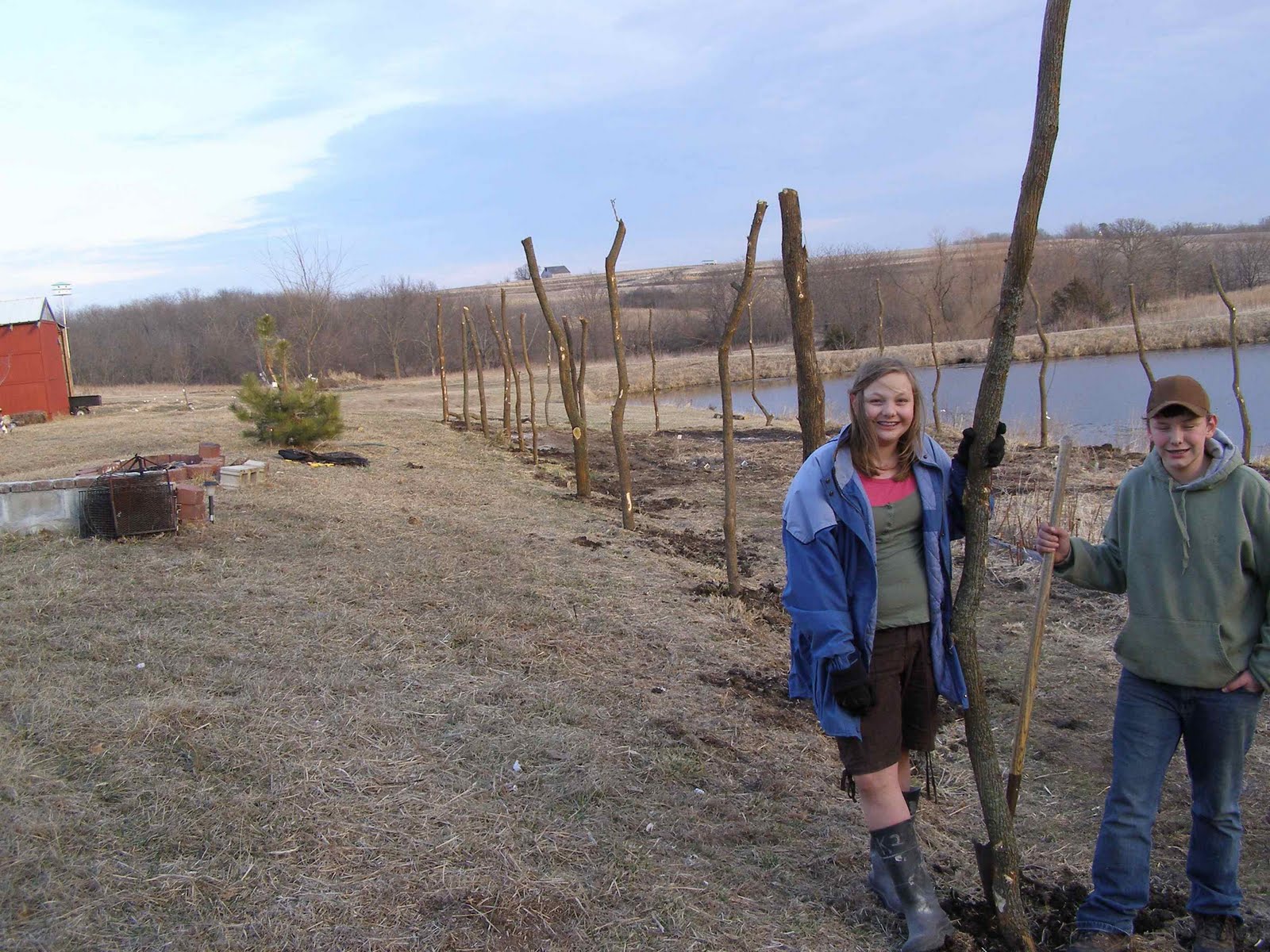
I have had a big vegetable garden for the past five years. In order to keep the critters out of it, I've had a 6-foot high fence made out of netting around it. It has served me well, but it was getting a bit worn and easy for said critters to breach. Also, I was spending some of the precious time I have for working in the garden repairing the fence for the garden. One morning, two large does were breakfasting on my brand new spinaches and lettuces. They were completely non-plussed when I tried to shoo them away. Rather than pulling out the big guns, literally, Hubby offered to help me re-do the fence.

We happened onto a sale on heavy-duty, tall, chicken wire at the local farm store. A neighbor offered to find us tall fence posts. All we needed to do was dig a few holes and pop those posts into them.

A piece of cake.

Yeah, right.

Here are some things to consider (for you non-farm types):

Can we get this project done before the asparagus starts coming up in early April (because, if we can't, the deer are going to have lunch, too.)

Can we get the old steel posts dug up and the netting cleared away so that we can put in the new stuff?

Is the ground thawed enough to dig into?

Is it thawed enough but not too wet to dig into?

Is the neighbor going to bring the posts when the ground is thawed and not too wet?

Can we dig 32 holes in a weekend?

Well, yes!! (to all of it!)

We started by digging holes by hand. After about one and a half holes, Hubby jumped in the truck and went to town to rent an auger for us. (What a guy!)


The gas-powered auger made things a bit easier, but it had to be man-handled (or, at times, woman-handled) and had no self-propulsion or lightness of being to it. :( We did get a system going and managed to bang out the 32 holes. (Our muscles suffered the consequences of this system the next day.)


We say "ni hao maa" here because this hole goes all the way to China. :) Seriously, though, the holes needed to be about 2.5 feet deep.

The ten-foot (plus) hedge poles were delivered about two hours behind schedule (much closer than 98% of the goings on at the farm) and promptly popped into their holes around the garden. Each pole was weighty enough to require two people to carry it, so, it was quite fortuitous that the now mostly-grown neighbor children showed up to help. In addition, daylight savings time had just kicked in so we had an extra hour of daylight to get it all done. We'll wrap the whole thing with the chicken wire next weekend. The hard part is done.


It was warm enough.
It was dry enough.
The auger was available to rent.
We had time to do it all.
The neighbor kids helped out.
The planets were aligned for Lizzie last weekend and she was well pleased!

We may even have more than three beets this year!

April 12, 2010

Priorities

For those of my blog fans which may not know the particulars of my family life, it is a bit schizophrenic. We live in Omaha, Nebraska, where Hubby has a great job which subsidizes our farm and supports more people than he would like to know about. (We invoke the "Don't Ask, Don't Tell" policy on that one.) But our farm is located in Southwestern Iowa, exactly 97 miles from our Omaha door. So, our farming is done largely on the weekends and in the summer. The upshot of this rubric is that we tend to pack a lot of farm work into just two days each week.

Sometimes we work so hard for the entire weekend, then sit for an hour to behold our handiwork, then Hubby comments that the place looks really nice for the noble landowners for whom we toil and who will show up during the week to enjoy the place.

But this past weekend was a bit more relaxed than usual.

Here's what was planned (it's spring and there's a lot that needs to be done):

- till the garden
- fix the holes in the netting around the garden
- plant the spring seeds (about 20 items!)
- fix the lawnmower
- fix the tractor
- fix the other tractor
- count the aronia berries
- mulch the aronia berries
- mow the 25-acre field
- plant the new roses
- water new grass seed areas
- gather up hoses from fields

Here's what we did on Saturday:

- planted new white pine and weeping cherry trees (which Liz got a great deal on at the local hardware store)


- watched Maya with her newly caught fish (She's a veritable fish-whisperer!)

- were visited by our neighbor, Marlin, who, when taking his leave of a friend of Maya's said, "Well, Dear, I'm glad you got to see me!"
- watched the kids go boating and swimming in the pond


- went into town to get a couple of things and look at the baby ducks at the farm store
- cooked hamburgers over a campfire
- listened to "A Prairie Home Companion" on the radio
- put up solar panels on Hubby's new barn -- woot woot! (Eventually) free energy!


- tinkered in the barn for a few hours
- watched the solar lights come on in the evening while sipping some wine

So, I guess life is what happens in spite of one's planning.

But, I'll have you know, somehow, everything on that planning list got done on Sunday.

Needless to say, Hubby and I were both absolutely fried on Sunday night, but it was worth it!

March 3, 2010

The Farmers in the Dell

The Organic Farming Conference is held annually in La Crosse, Wisconsin, during the last week of February. A hopeful sign of the times is that attendance has grown from 90 attendees 21 years ago to a resounding 2,600 this year!

One of the fixtures of the conference is the appearance and irreverent folk songs of Sinister Dane and the Kickapoo Disco Cosmonauts. (Don't look for them online. They don't have time to put up a website. They're busy farming and playing music.) They write their own lyrics to popular songs. You can probably guess the tune to "Help me, Round-up, Help, help me Round-up". Or, how about the tribute to Patsy Cline, "Cra-zy, for feeding sheep's brains to cattle...".

All of the food at the conference was organic, of course. All that could be recycled, was. Each attendee was given a glass mug to use for the duration of the conference. (No paper or styrofoam cups.) It took some years, but there were even compost buckets for things like banana peels and apple cores. Bravo! There was more tea than coffee doled out. The conference organizers didn't even bother with vegetarians. They jumped straight to vegans and gluten-free folks.

There were farmers of all kinds -- Amish, Mennonite, Sikhs, certified organic farmers, Birkenstock-wearing students, crusty old guys in seed company caps, university researchers, even a smattering of conventional farmers (they'll be converted soon). An encouraging note was that there were many young, beginning farmers.


I've worn many hats in my life (teacher, traveler, designer, artist, spy) but I must say that that of a farmer has been the most interesting by far. If you are anything like I was before venturing into this vocation, you may have assumed that farmers were dull, unintelligent hicks. That is what society has shown us about them. And the image is further degraded by conglomerates like Monsanto which have turned farmers into little more than hired hands, caught in the genetically-engineered seed/Round-up pesticide cycle.

But the average family farmer is nothing like that.

There is an authenticity to farmers. There is a common bond among us, borne of the feeling of comrades-in-arms as we all work with, or fight with, Mother Nature. There is a true grounding, literally and figuratively, to those who work on the land. There is a leanness to life. There is an innate intelligence in figuring out any number of measurements. There is a keen sense of community, helping each other, joining forces. There is immeasurable respect among the ranks of farmers.

I am honored to be one of them.


November 24, 2009

Down and Dirty

Having ventured into non-agricultural prose for a few entries now, I realize that it's high time to get back to what's going on at the farm, so here's an update on the aronia berries.

After getting them all in the ground, we spent the next few weekends walking the berries. We were a bit chagrined to find out that the cohabitants of our land, namely the deer, are curious creatures. They like to pull out the tiny plants and then drop them near where they were so nicely planted. They don't eat them. They don't like them. They're just mischievous little devils.

Fortunately, once replanted, the little seedlings are not much the worse for wear. The only problem is when we can't find the little seedlings. Imagine trying to find a brown stick about five inches long with a root ball about the size of a golf ball on the dirt ground among the dead weeds from the past summer. Ugh!

We estimated that we had about a 5% loss the first weekend. The next weekend, things were similar, but not as bad as the first weekend. The berries have now lost their leaves and the deer have probably had their curiosity satisfied.

So, the next big chore is to mulch between the berries to keep the weeds down next spring. We use hay from our organic fields and consider it our secret weapon in the fight against weeds. It works splendidly for the garlic because the new garlic shoots just push right up through it in the spring. With the berries, however, we have to leave the little shoot exposed to the sun and mulch around each one...a much more labor-intensive proposal. So, as Andre gathers hay bales and delivers them to the rows, I am on my hands and knees spreading hay between plants.

And guess what? You see a lot more from this position, at least when we're discussing the earth. It seems when we walked the berries, we weren't close enough to the actual plants to be sure of what we saw. As I commune with them at their level, I see a short shoot more easily than when I was standing. It turns out our estimate of 5% loss is quite high! Maybe farming isn't so hard after all. (Read: she's fooling herself again here.)

After hefting 50-pound bales of hay, breaking them apart, spreading them on the ground, doing my best inchworm imitation for a couple of hours this past weekend, I am aware of muscles I didn't know I had, only because they are burning in pain.

And only about 20% of the job is done.

Ah, but Thanksgiving is coming up and there will be offspring to help!

Yeah, right.

October 5, 2009

Material Girl

Thanks to all who sent out encouraging thoughts this past weekend as we conquered the planting of 1,000 little aronia berry seedlings. It must have worked because all went swimmingly! In farming, the odds for such success are usually against us.

Kim, Rick, John, and Dec all showed up to help. Thank you all! Without you, it wouldn't be done now. A nice lunch was had by all. Andre stayed late to make sure each tiny plant was watered in.

During a break in the planting, Andre had gone into town (about 10 minutes away) with Maddie. After what seemed like longer than it should have been for them to return, Maya voiced the same thing that Dec and I were thinking..."where are Dad and Maddie? They've been gone a long time."

"Hmm. I don't know. I wonder what's keeping them." I responded.

Maya replied, "Maybe they've been murdered."

"Oh, I doubt it, Honey. Don't worry." I assured her. After all, it's not hunting season quite yet.

After a pregnant pause, Maya found a silver lining to her dire scenario.

"If they're dead, I call Dad's Blackberry!"

She'll text you with the details of the funeral.

JK

July 8, 2009

The Tao of Farming

Live and learn.


You win some, you lose some.


C'est la vie.

All these axioms may help us face little failures in life but I'm seriously considering putting farming in a class by itself.

Farming's axioms could include:

No matter what you do, you will fail.


Everything is for naught.


It's a zero-sum game and you'll get zero as the sum. Every time.

You get the idea.

Here is a photo of our beautiful wheat that is just about ready to be harvested. Last year, we lost most of our wheat crop to the floods and we didn't have insurance. We did manage to recuperate some of our losses as organic wheat went for $18/bushel (as compared to regular wheat that was going for about $5/bushel) and we got about 50 bushels off our land. (We should have gotten over 700 bushels.) So, we were able to pay for the combining, had a little money from the wheat, and milled some of it into flour for our CSA members and ourselves.

We re-planted wheat for this year AND took out insurance on it. (We're pretty bright.)

Well, last weekend, we traveled around our land and were thrilled that the wheat was looking very good (full heads, ripe, drying out like it should) and the clover and grass we planted this spring was coming up just as we hoped under the wheat to make hay in the late summer and fall. Of course, not all the fields were primo, but the fact that SOME were really excited us. Our farm was really coming along. It wasn't simply comprised of weed fields anymore. Our planning was working out. And, remember, we were insured.

What could go wrong?

We did what we always do. We called our mentor, Dan, to schedule the combining of our lovely wheat. He had the sad duty of informing us that organic wheat prices had fallen to $6/bushel.

WHAT???????

OK. OK. Let us recover ourselves. OK. We'll be OK. We had counted on the insurance to pay around $9/bushel. But that would only happen if the crop failed. What do we do now that we have good wheat that will only bring $6/bushel?

Do you see how unfair this all is?

So I proceeded to call the local grain dealer to find out the exact going price of organic wheat. Kevin was very happy to take my call but also had a sad duty to perform. Not only is organic wheat going for very little, it is not going AT ALL. He knew of NO ONE wanting wheat. Everyone he knows has wheat leftover from last year. He is recommending that we find a place to store our wheat (another expense) for at least two months and then, MAYBE, we'll be able to sell it. No guarantees.

Too bad we didn't have the floods this year.

July 1, 2009

All Grown Up

"When I was a boy of 14, my father was so ignorant I could hardly stand to have the old man around. But when I got to be 21, I was astonished at how much the old man had learned in seven years." Mark Twain

And a less benevolent, albeit true-at-times one,

"
Mothers of teenagers know why animals eat their young." Unknown author

But I digress.

Let's stick with the Twain quote. It's much more appropriate.

My eldest daughter called me today with a question I have been waiting 20 years to field: "Tell me about my heritage." My first reaction was to laugh with recognition that yours truly was about the same age when she had the wonderful opportunity to spend some months with her own grandparents, basking in their love and picking their brains for that all-too-dwindling oral history of our family.

My response was to refer her to my initial entries about our ancestry: I Finally Got One and Coming Full Circle Times Two. Not to brag, but these do seem well-written and succinct, two qualities appreciated by the young.

Her next question was just as much fun.

"What, exactly, is meant by 'organic'?" (See recent entry about said daughter's new job.)

I love it!

So, I proceeded to give her about an hour's worth of organic farming, from the global issues of sustainability and feeding the world's population to the big, bad evil Monsanto, Syngenta and Bill Gates and their monopoly on conventional farming and their interest in the Svalbard Seed Vault to the history of farming itself to the reason organic food is here to stay to the politics of it all and everything in between.

I could feel her almost taking notes over the phone.

"Wow, Mom, you know so much! Can you jot the main points down and send them to me in an email?" So, I guess I get to take the notes. Oh, well. That's OK.

I'm just glad I was ready and had learned so much in the past seven years.


June 23, 2009

Always Listen to Your Mother

Joined by our four wonderful girls, we enjoy life on the farm as often as we can.

I must come clean.

Even though this sentence can be found in the About Me part of this blog, it is not entirely true. Most weekends, we are joined by our two younger daughters -- Maddie, 11 and Maya, 8 -- over whom we still hold some sway, which is tenuous at best. (As a friend/therapist reminded us recently, our job as parents was pretty much done when they were 4 or 5 years old.)

The older two girls -- Julie, 20 and Amelia, 18 -- are off on their own now and can't be bothered with this organic farming experiment that the old folks are on.

Therein lies their mistake! (Bwah-ha-ha)

A recent case in point:

Julie, our 20-year-old, recently called me to tell me that she was being sent to a trade show in Chicago as part of her new job. She called me as she was on her way to the show. She was panicking. She felt out of her element and at a loss, lacking in background. This is the young woman who has traveled the globe, commands the respect of her peers and colleagues at Loyola University, and can talk her way out of just about any situation -- in two languages! But she never really wanted to pay attention when the subject was organic farming.

I pause to take a moment to revel in the satisfaction that rarely comes with motherhood.

Her new job, you may ask?

Representative for the the Agricultural and Fisheries Division of the Quebec Delegation in Chicago.

The trade show she was attending?

The All Things Organic international trade show.

Can you say karmic justice?

June 9, 2009

Re-thinking That "Green is My Favorite Color" Entry

So, I've mentioned previously that I'm hopelessly in love with Spring. Well, yes, after a winter in Nebraska and Iowa anyone would be, I suppose. But, heady with all the new life of the season, I forgot about the other green things that come with the season, namely, weeds.


But, before we tackle them, let us enjoy the memorable fishing experience that Maya had with our beloved GodCarol (yes, she is very close to the Almighty). We stocked our pond three years ago and had not fished a single item out of it, mostly because we are not fishermen. Carol happens to be an expert and shared her knowledge with Maya and actually caught a decent fish! Thanks, Carol! Now we know that our pond has fish in it. And we have Maya, the eight-year-old, to teach us what to do to repeat the event.


The problem with Spring is that many folks want to usurp it for their own purposes. It's not just the time that life returns. It is also the time when the school year ends, children graduate, (I've got one in the above picture and will have more in the years to come, as you can see), and, because of said graduations, relatives arrive to visit, dinners must be prepared, couples argue about said relatives and dinners, other couples get unnerved about the family presence itself, other members chafe at each other because they are not used to each other, other members contemplate the meaning of life and relationships and everything under the sun.

All of which brings me back to the weeds. The weeds at the farm are almost out of control. (I'll get to them eventually, don't worry.) But I am reminded of a National Geographic article I read about ten years ago. It featured an African farmer who grew a crop for grain. It was full of weeds. When some well-intentioned Westerner asked him why he allowed the weeds to grow rather than killing them with some Round-Up type of herbicide, the farmer responded that he harvested the weeds and fed them to his cattle. Given the desert conditions, he was glad to have the weeds to feed to his animals.

Another anecdote that came to mind while contemplating the omnipresent weeds was the one where the neighbors of a certain homeowner got together to comment on said homeowners lack of mowing. The response by said homeowner was that he was "growing children that year". This is our thought as we notice our grass growing at home. Mowing is not high on the priority list when you have live, little beings clamoring for your attention.

But back to tackling the weeds...just last weekend, one of said relatives, my sister, Dec, spent a couple of hours cleaning out the Brussels sprouts, cabbages, and cauliflower. They should do well now. We also mulched the tomatoes and peppers and eggplant before the weeds can take over. I still need to clean out the herb garden and the asparagus bed. And don't get me started on the potatoes and squashes! Ugh!

I guess it's the price one pays for growing things that you want amidst things that you don't want. But those things you don't want are part of the life that comes in the spring. :)

January 29, 2009

Coming Full Circle, Times Two

Part One

Once upon a time, in a small county, in a quiet place, a young man decided to build a farm.

*Etching of Farm of Prier Squire Wilson,
my Great-Great-Great-Grandfather.
"Out the old Eddyville Road at the First Bridge",
Ottumwa, Iowa, circa 1850.

The generations that followed him were peopled with more farmers, teachers, an engineer and inventor (my Great-Grandfather, Fred Wilson, invented a corn picker, among other things), more teachers, I'm sure (note to my children: we've more than fulfilled our quota of teachers for one family. You may all go and do other things...please!), a girl who married a traveling salesman who became a millionaire, and, eventually, a psychologist named Jan. (Stay tuned.)

Part Two

Once upon a similar time, in a small kingdom, in a faraway place, another man (actually a boy of about 14 years) decided to hop on a boat and go halfway around the world to seek his fortune in a new land. He left his hilltop village in the Pyrenees and sailed to New York with a tag around his neck saying, "Jose Serrano, Hollister, California" where he would go and tend sheep (something Basques are good at) as per his sponsor's arrangement. He later bought some dry, desert land in the Central Valley of California. Today it is the richest producing land in the world. (Just add water.) His son was a cattleman and hay farmer.
His grandson got his doctorate in history (and, yes, became a teacher) and his name is Martin.

Denice and Fermin Larrey, my Grandparents,
with a prize-winning cow, circa 1940.


Martin and Jan met in high school in California and later married. Each went on to much higher education and had us five children. The only giveaway that they had come from farm families was the garden we always managed to grow, wherever we lived. Some of my earliest memories are of planting, weeding, harvesting. I also remember visiting my Grandparents' farm and climbing on haystacks, and going horseback riding, and milking cows. It all seemed so far away from what was going on in my immediate family where academics and study were so valued (not that that's a bad thing, mind you). But, as I think about it now, I remember some other things. My Mother cooked what was in season. (It's all the rage, now, but then it was just the way good cooks cooked.) We shopped at farmers' markets whenever we could. (It wasn't chic, it was the way to get the best-tasting food.) My Grandparents sent oranges and almonds from California at Christmastime, when they were at their best. What a treat! So, the rhythm of the seasons was living on in them and being passed on to me all along.

I grew up and went on wonderful adventures overseas, became a spy for a while, had some higher education myself, and, you guessed it, became a teacher. Then I met my husband, Andre, who is Russian. Russians have a very strong, vibrant tradition of having a family farm, a plot of land, a dacha. So, Andre and I spent a couple of years looking for our own piece of land. We found it near Clarinda, Iowa, about 150 miles from where my Great-Great-Great-Grandfather did the same thing over 150 years ago. What a circle!

Our dacha compound near Clarinda, Iowa.